The 2025/26 tax year introduced major changes to employer National Insurance Contributions (NICs). Since April 2025, the employer NIC rate has increased from 13.8% to 15%, the per-employee threshold has fallen to £5,000, and the Employment Allowance has risen to £10,500.
By October 2025, many SMEs are already feeling the impact. While the higher allowance helps the smallest employers, most businesses with multiple staff are facing a noticeable rise in payroll costs.
👉 In this guide, we’ll recap what changed in April, show worked examples of the extra costs, and, most importantly, explain how you can plan ahead to manage the new reality through the rest of 2025/26 and beyond.
💡 For a full breakdown of payroll costs beyond NIC, including PAYE, pensions, and hidden payroll fees, see our Payroll Services UK Guide.
👉 You can also check the official GOV.UK NIC rates and categories.
What Is Employer NIC? UK Payroll Explained 2025/26 for SMEs
Employer National Insurance Contributions (NICs) are a payroll tax paid by employers on employee earnings above a set threshold. They are separate from the NICs paid by employees and are one of the biggest hidden costs of employing staff in the UK.
In simple terms:
- Employees pay NICs out of their wages.
- Employers also pay NICs on top of wages once earnings cross the employer threshold.
- The higher your payroll bill, the higher your employer NIC liability.
For many SMEs, employer NICs are the second-largest payroll cost after gross salaries, which is why even small percentage changes can have a big impact on cashflow.
👉 You can always check the latest official rates and thresholds directly on GOV.UK: National Insurance rates and categories.
💡 Want to see how these NIC costs compare across different payroll solutions? Read our guide on Payroll Outsourcing Costs UK.
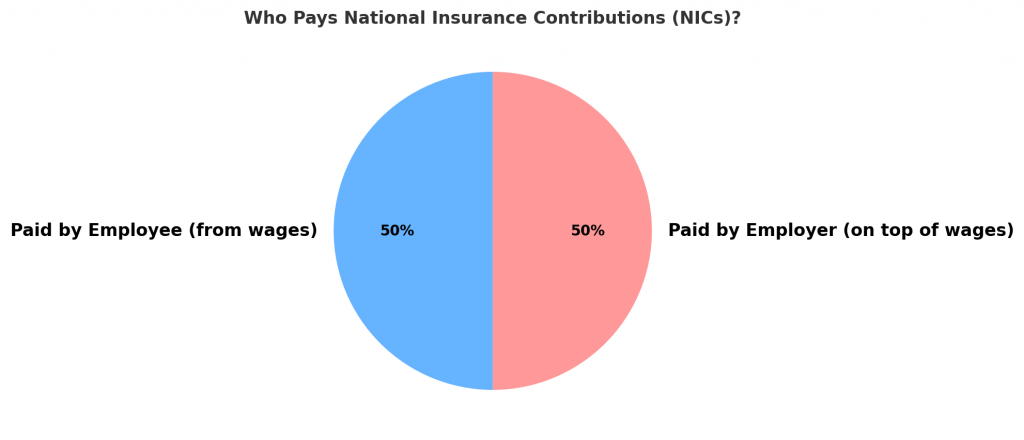
Employer NICs are paid on top of wages, while Employee NICs are deducted from wages. UK 2025/26 payroll explained.
Employer NIC Changes 2025/26: Key Facts for SMEs
From 6 April 2025, the rules for employer National Insurance Contributions (NICs) changed. By October 2025, SMEs have already had half a year to adjust — but the impact on payroll costs is becoming clearer.
Here are the headline changes every employer needs to know:
- Employer NIC rate increased → from 13.8% to 15% on earnings above the threshold.
- NIC threshold lowered → the first £5,000 per employee per year is exempt (down from £9,100 in 2024/25).
- Employment Allowance increased → eligible small businesses can now claim up to £10,500 off their annual employer NIC bill (up from £5,000). See GOV.UK: Employment Allowance guidance.
- Directors and family-run companies → Employment Allowance is not available if the only employee is a director paid above the threshold.
These changes mean that while micro-businesses with 1–2 employees may see savings thanks to the higher allowance, growing SMEs with multiple staff will generally face higher payroll costs overall.
💡 To stay ahead, it’s smart to build NIC costs into your payroll cashflow forecast. Our Cashflow Forecasting Guide shows how to model these expenses so there are no payday surprises.
Employer NIC Cost Impact 2025/26: Worked Examples for SMEs
The new NIC rules aren’t just numbers on paper, they directly affect your bottom line and payroll costs. By October 2025, many SMEs have already seen their NIC bills rise, even after factoring in the higher allowance.
Here’s what the 2025/26 changes mean in practice:
- Single employee on £25,000 salary
- 2024/25: Employer NIC = ~£2,200
- 2025/26: Employer NIC = ~£3,000
- Extra cost: ~£800 per year
- Team of 10 staff, average £30,000 each
- 2024/25: Employer NIC bill = ~£28,840
- 2025/26: Employer NIC bill = ~£37,500
- Extra cost: ~£8,660 per year (even after Employment Allowance)
- Smaller business with 2 staff, £20,000 each
- 2025/26 bill = ~£4,500, which is fully offset by the £10,500 Employment Allowance.
- Net NIC cost: £0.
👉 The key takeaway: the bigger your payroll, the bigger the hit. While the £5,000 threshold and allowance protect micro-employers, most SMEs with 5–30 staff will feel a noticeable rise.
💡 For a full picture of how NICs interact with PAYE, pensions, and hidden payroll costs, see our Payroll Services UK Guide.
👉 Try the official GOV.UK NIC calculator to estimate your exact liability.
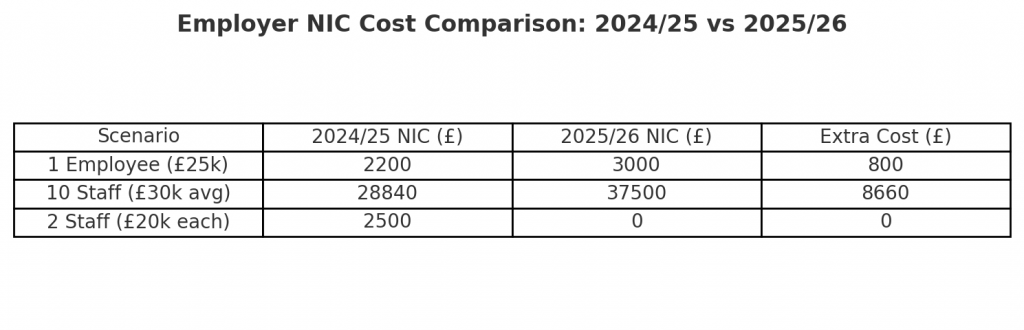
Employer NIC cost comparison UK: 2024/25 vs 2025/26 for 1 employee, 10 staff SME, and 2 staff micro-business. Shows £5,000 threshold and 15% rate impact.
Who Wins and Who Loses Under the 2025/26 Employer NIC Changes (Explained for SMEs)
The NIC changes introduced in April 2025 are not felt equally across all employers. By October 2025, clear patterns have emerged in terms of who benefits, who loses, and who sees little difference.
✅ Likely Winners
- Micro-businesses with 1–2 staff
- The £10,500 Employment Allowance wipes out much (or all) of their NIC bill.
- Seasonal or low-payroll employers
- Lower-paid staff may fall under the £5,000 threshold for longer.
❌ Clear Losers
- Growing SMEs with 5–30 staff
- Example: 10 staff on £30,000 → NIC bill rises by ~£8,660 in 2025/26.
- Labour-intensive industries
- Care providers, hospitality, and service businesses feel the greatest rise.
➖ Neutral or Mixed Impact
- Large payroll companies
- Always over the allowance, now paying more, though the percentage uplift is smaller.
- Director-only companies
- If the only employee is a director, the business cannot claim the Employment Allowance.
👉 You can check official eligibility rules on GOV.UK: Employment Allowance.
💡 Tip: If you’re in the “loser” category, model NIC costs in your payroll forecast and explore director remuneration strategies. See our Cashflow Forecasting Guide.

Employer NIC changes 2025/26 UK: winners include micro-businesses and seasonal employers, losers include growing SMEs and labour-heavy sectors, neutrals include large payroll and director-only companies.
Impact of Employer NIC Changes on Hiring & Growth Decisions
For many SMEs, payroll is the single largest cost, and with the employer NIC rate rising to 15% in 2025/26, staffing decisions are under more pressure than ever. By October 2025, some clear behavioural shifts are already emerging.
How NIC Changes Are Influencing SMEs
- Delaying new hires
- Greater use of contractors or outsourcing
- Increased focus on automation
- Revisiting remuneration strategy
What This Means for Growth
- Short-term squeeze: Expansion costs are higher.
- Long-term planning: Forecasting NICs helps avoid cash crunches.
- Compliance pressure: Outsourcing payroll reduces risk of mistakes.
👉 For a detailed breakdown of the true costs of outsourcing, see our Payroll Outsourcing Costs UK Guide.
👉 Use the official GOV.UK Employer NIC calculator to model your liability.
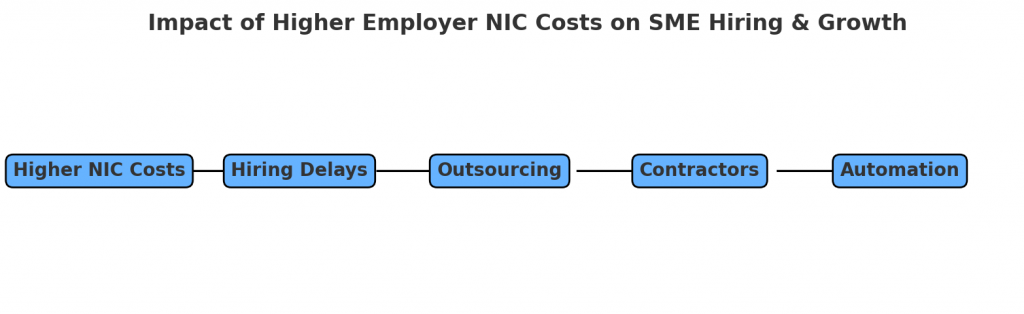
Impact of 2025/26 employer NIC changes on SME hiring and growth.
How to Plan Ahead & Minimise the Impact of NIC Changes
The NIC rise to 15% in 2025/26 doesn’t have to derail your growth. With the right strategies, SMEs can stay in control of payroll costs.
- Build NIC into cashflow forecasts 👉 See our Cashflow Forecasting Guide.
- Review company structure (salary vs dividends).
- Maximise the Employment Allowance 👉 GOV.UK guidance.
- Consider payroll outsourcing 👉 See our Payroll Services UK Guide.
- Plan workforce growth carefully.
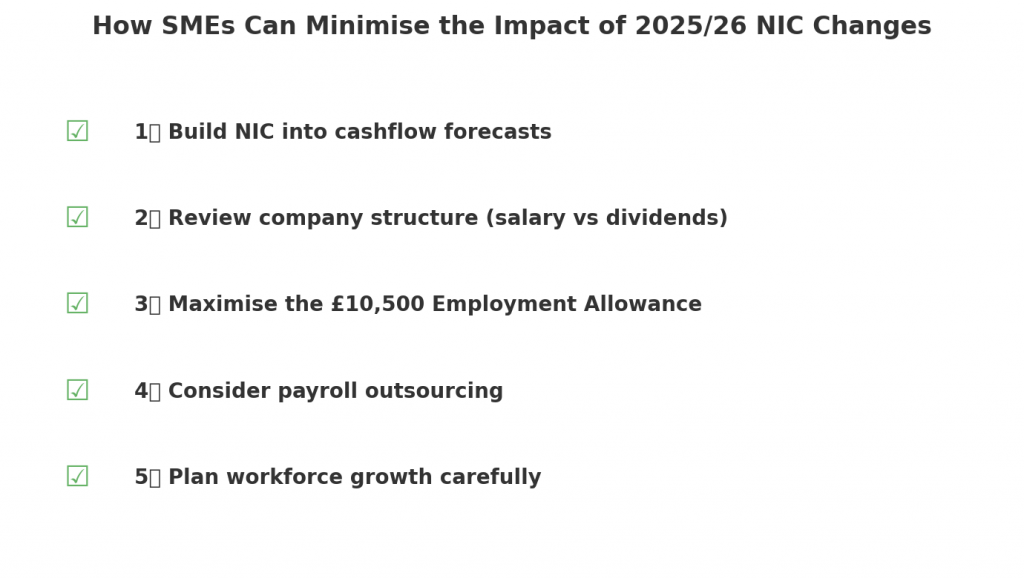
How SMEs can minimise the impact of 2025/26 NIC changes.
Employer NIC Changes 2025/26 – FAQ
Q: What is the employer NIC rate for 2025/26?
A: 15% on earnings above £5,000. 👉 GOV.UK NIC rates
Q: What is the NIC threshold for 2025/26?
A: £5,000 per employee per year.
Q: What is the Employment Allowance in 2025/26?
A: £10,500 (not available to director-only companies). 👉 GOV.UK: Claim Employment Allowance
Q: How much extra will SMEs pay?
- 1 employee on £25,000 → +£800
- 10 staff on £30,000 → +£8,660
👉 See our NIC Cost Impact Guide.
Q: How can SMEs reduce NIC impact?
Forecast, claim allowance, review remuneration, outsource payroll. 👉 See our Cashflow Forecasting Guide.
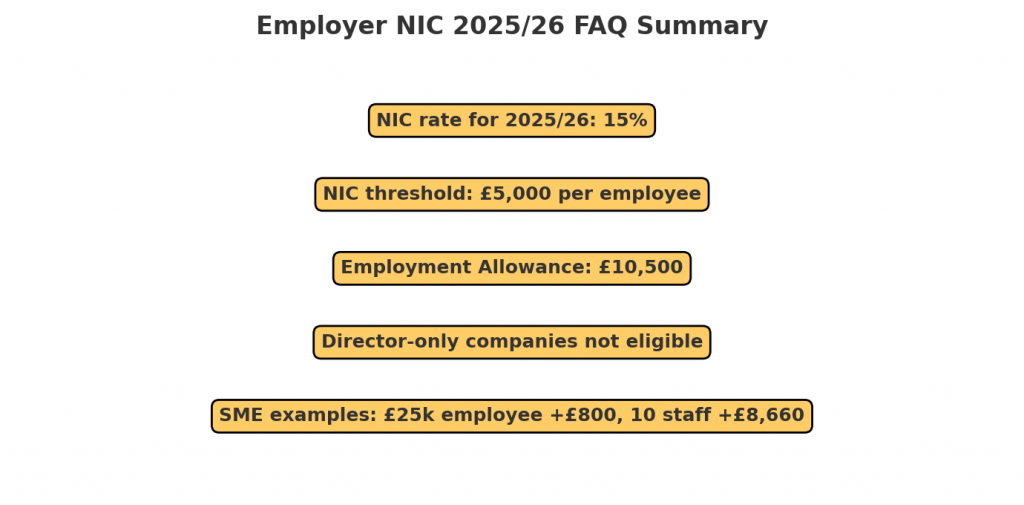
Employer NIC FAQ 2025/26 with rates, thresholds, allowance and SME examples.
Get Clarity on Your Employer NIC Costs
The 2025/26 employer NIC changes have already increased payroll costs for most SMEs, and the impact will only grow as your business expands. The good news? With the right planning, you can stay ahead.
At Heights Accountancy, we help SMEs:
- Model NIC costs in forecasts.
- Claim Employment Allowance correctly.
- Review director remuneration strategies.
- Outsource payroll with confidence.
👉 Book a free 30-minute Financial Clarity Call today.