Most owners expect a big bill (or a messy handover). In reality, switching costs are predictable when scope is clear, records are accessible, and deadlines are managed. Below, we break down what’s included, when clean-up is chargeable, and how to compare proposals like a CFO, not just on the headline fee.
Related reads: see Changing accountants in the UK (2025/26) for the end-to-end process, Old vs new: your first 90 days for service benchmarks, and How to choose an accountant for review questions that surface hidden fees.
Key facts (so you’re not guessing)
- Agent access isn’t a blocker. You can remove an old agent and authorise a new one; methods vary by tax. New authorisations replace old ones. GOV.UK
- VAT uses a “digital handshake.” Your new accountant sends a secure authorisation link; never share logins. GOV.UK
- Companies House codes come from the source. Request or refresh your authentication code (posted to your registered office or an eligible home address). GOV.UK
- Deadlines continue as normal. PAYE payments are due by the 22nd if paying electronically; VAT returns/payment are usually one calendar month + 7 days after period end. Late payments can attract interest/penalties. GOV.UK
What’s typically included in an onboarding fee
This is the “switching” work a good firm builds into a one-off or the first month’s fee:
- Discovery & acceptance: fit, scope, AML/KYC checks (change of appointment is a standard professional process).
- Professional enquiry (“clearance”): contacting the previous accountant and requesting reasonable transfer information.
- Agent setup: HMRC authorisations across SA/CT/PAYE/VAT/CIS (incl. VAT digital handshake). GOV.UK
- Core data import: last signed accounts, detailed trial balance, journals, fixed-asset register, VAT workings, payroll YTD/RTI, CIS summaries, software access (Xero/QuickBooks).
- Opening position: reconcile brought-forward balances and document any known issues.
- Deadline map: lock the PAYE/VAT calendar so nothing slips (and interest doesn’t accrue). GOV.UK
Heights Tip: If a proposal says “free onboarding,” check what’s actually included. If opening reconciliations or agent authorisations are excluded, you’ll see it later as “ad-hoc” time.
Typical cost ranges (guide)
Every firm prices differently, but these bands are a realistic guide for SMEs:
| Situation | What it looks like | Typical onboarding fee* |
|---|---|---|
| Straightforward switch | Clean software, recent reconciliations, cooperative outgoing firm | £300–£800 |
| Moderate tidy-up | Some unreconciled items, gaps in documentation | £600–£1,500 |
| 30+ staff service SME (complex switch) | Multiple bank accounts, payroll complexities (benefits, starters/leavers), prior VAT queries and partial clean-up. Structured onboarding with liaison to outgoing firm, opening balance rebuild, VAT/PAYE calendar lock-in, and management reporting setup. | £2,000–£3,500+ |
*Indicative only; ongoing monthly fees depend on scope (bookkeeping, payroll, VAT, management accounts, forecasting, tax planning).
If you’ve simply outgrown a compliance-only service and want proactive support (monthly reviews, management accounts, a 52-week forecast, board-ready packs), expect the ongoing fee to anchor higher, with a clear value narrative and fewer surprises.
Next: see Old vs new: your first 90 days for what “good” looks like in practice.
“Cost by situation” (at-a-glance)
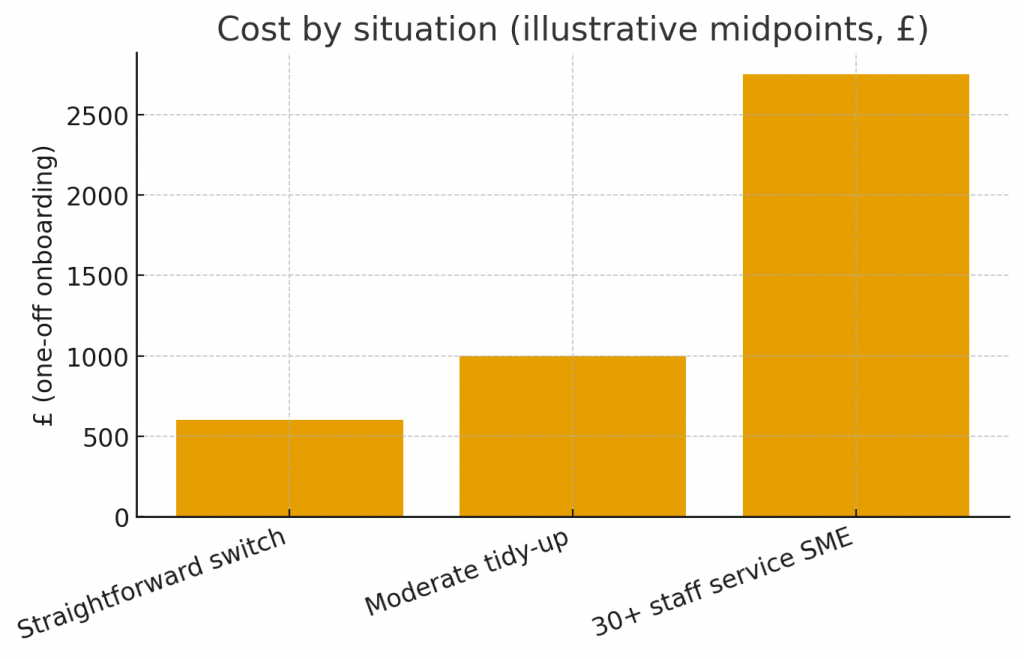
Illustrative midpoints of each range: £600, £1,000, £2,750.
What can trigger extra cost (and how to avoid it)
- Missing records (bank statements, purchase evidence) → slows opening reconciliations.
- Historic errors (misposted VAT, payroll misalignments) → require journals and sometimes resubmissions. Avoid interest/penalties by fixing early. GOV.UK
- Manual data extraction from a system you can’t access → push for “reasonable transfer information” first to limit time.
Prevention checklist: use the Switching Accountant: 14-Point Checklist (PDF) to gather the right documents up front and reduce clean-up time.
How to compare proposals like a CFO (not just on price)
Ask each firm to show:
- Scope table: bookkeeping cadence, payroll, VAT, CIS, management accounts, tax filings, year-end, advisory.
- Response & review rhythm: same-day/next-day email SLA, monthly/quarterly reviews, who attends, and what you receive.
- Opening balance policy: what’s included vs billed as clean-up.
- Agent & platform setup: who does what; security via VAT digital handshake (no password sharing). GOV.UK
- Deadline guardrails: how they ensure PAYE (22nd) and VAT (one month + 7 days) are never missed. GOV.UK
Related: read How to choose an accountant for a ready-to-use question list and review checks.
Worked scenarios (so you can benchmark)
- Five-person service business (clean records): agent setup + opening reconciliation + deadline map. One-off £450–£750; ongoing depends on whether you keep bookkeeping in-house or outsource.
- Ten-person agency (some tidy-up): unreconciled items and VAT review. One-off £800–£1,400; ongoing higher if you add monthly management accounts + 52-week forecast.
- 30+ staff service SME (complex switch): multiple bank accounts, payroll complexities (benefits, starters/leavers), prior VAT queries and partial clean-up. Structured onboarding with liaison to outgoing firm, opening balance rebuild, VAT/PAYE calendar lock-in, and management reporting setup. One-off £2,000–£3,500+; ongoing depends on transaction volume, payroll frequency, management accounts, and advisory cadence.
Heights Tip: The real cost is allowing penalties/interest to creep in during a switch. Keep PAYE/VAT dates visible from day one. GOV.UK
What you should never pay for
- Your old firm sharing your logins (unsafe). The correct route is agent authorisation and the VAT digital handshake. GOV.UK
- “Access fees” to remove themselves as agent. You can remove an agent in your HMRC account. GOV.UK
- Mystery “file release fees” for basic transfer information, professional guidance expects reasonable transfer information to support continuity.
FAQs
Is it free to switch accountants?
Sometimes. Many firms include standard onboarding in the first month’s fee. Clean-up (missing records, unreconciled items, historic corrections) is typically extra, get it itemised.
Do I need to tell HMRC I’ve changed accountants?
Your new firm will request agent authorisations; you can also remove an old agent yourself. GOV.UK
Why does VAT authorisation feel different?
VAT now uses a digital handshake via the Agent Services Account, a secure authorisation link instead of sharing credentials. GOV.UK
Can I avoid interest/penalties while switching?
Yes, deadlines continue as normal (PAYE by the 22nd, VAT usually one month + 7 days). Your new firm should map these on day one. GOV.UK
What if my old firm is slow to hand over?
Point to professional expectations for reasonable transfer information and keep your switch moving with the documents you already hold.
What to do next
- Download: Switching Accountant – 14-Point Checklist (PDF) to keep onboarding costs tight.
- Read next: Old vs new: your first 90 days for the service contrast, and How to choose an accountant for the questions that flush out hidden fees.
- Book a 20-minute planning call: we’ll price your switch transparently, map your deadlines, and switch on your 52-week forecast so cash, VAT and PAYE are visible 4–6 weeks ahead.