
Short version: an outsourced finance team, often called a Virtual Finance Office (VFO), gives you the outcomes of a whole finance function (bookkeeping, AR/AP, month-end reporting, cashflow, and FD-level direction) without hiring four different roles. You keep the human benefits (named people, fast replies, continuity) and gain the flexibility to scale effort up or down.
New here? If you’re still mapping roles, start with Bookkeeper vs Accountant vs Finance Manager (UK): Who Does What, When. When you’re pricing the bookkeeping layer, see Bookkeeping Outsourcing Costs UK (2025/26): The Complete Guide for SMEs.
What an outsourced finance team actually covers
A modern VFO mirrors the building blocks of a bigger company’s finance department, right-sized for an SME: accounts receivable (AR), accounts payable (AP), financial reporting and control, working capital/cashflow, budgeting & forecasting, strategic finance, and tax & compliance (HMRC/Companies House).
Outcomes you should expect:
- Regular bookkeeping done properly (bank feeds, tidy ledgers, reconciliations).
- Management reports with clear commentary so decisions aren’t waiting on numbers.
- Live cashflow that actually factors PAYE, VAT and corporation tax, so nothing blindsides you.
- AR/AP controls that shorten debtor days and avoid payment risk.
- Strategic input on pricing, “what-if” modelling, funding and exit planning, plus investor-ready reporting.
Why it often beats hiring (especially 10–40 staff)
- Coverage, not key-person risk. A team can cover sickness/holidays, keep your reporting timetable on track, and absorb short-term peaks.
- Flexibility. Dial services up/down as you grow—hard with fixed headcount.
- Breadth & best practice. Access controller/FD expertise and the current cloud-accounting/app stack to save time and reduce errors.
- Human, not “just tech.” Despite the word virtual, service is people-led (named senior contact, unlimited support).
Comparing models? See Bookkeeper vs Accountant vs Finance Manager (UK) to pick what you keep in-house vs outsource.
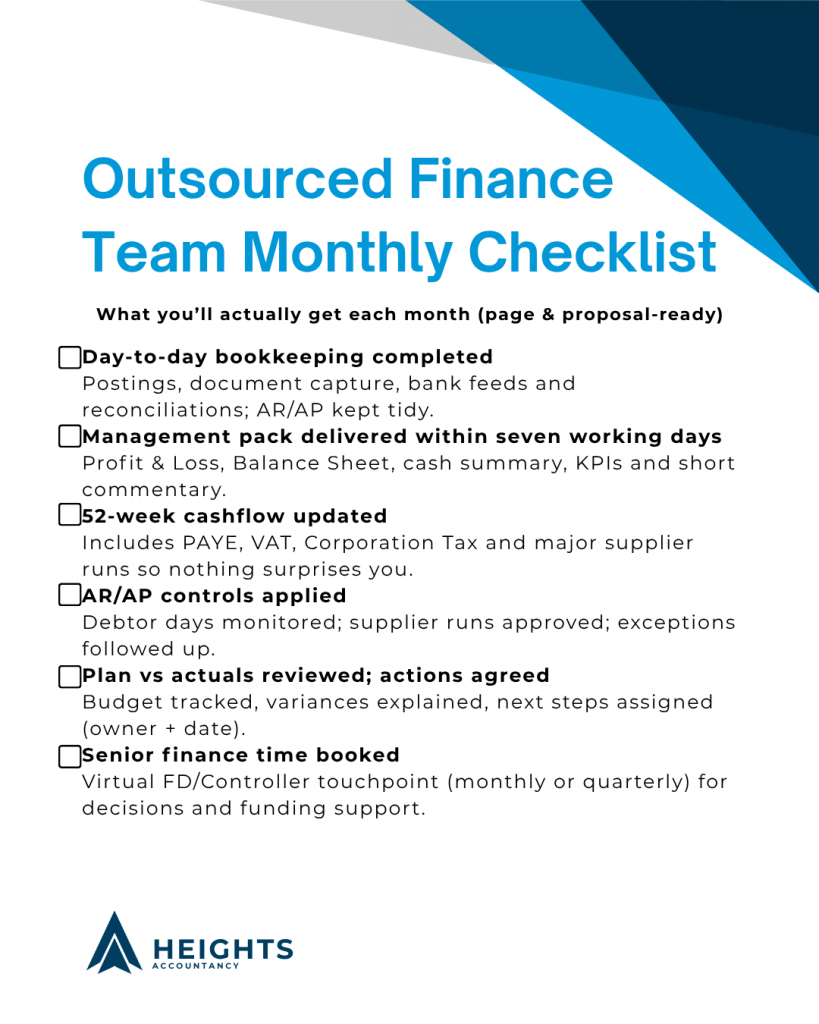
What you’ll get each month (plain English)
- Day-to-day bookkeeping: postings, capture, reconciliations, tidy AR/AP.
- Management pack: P&L, balance sheet, cash summary, KPIs, with short commentary—delivered promptly after month-end.
- Cashflow discipline: a live view (think 52-week horizon) covering PAYE, VAT, CT, and big supplier runs.
- Quarterly planning: plan vs actuals, “what-ifs” (hiring, price changes, new services).
- Senior input on tap: a dedicated FD-level contact plus team backup, with unlimited email/phone support.
Will it fit our size? (right-sized paths)
- 5–10 staff: keep AR/AP comms close to home; outsource bookkeeping + monthly reporting; borrow controller time for cash and debtor discipline. (If you’re choosing between roles, read Bookkeeper vs Accountant vs Finance Manager (UK).)
- 15–25 staff: outsource bookkeeping + management accounts; add fractional controller ownership of the reporting timetable and cash; use FD quarterly for pricing/hiring decisions.
- 30+ staff: treat the provider as your outsourced finance team: AR/AP → controller → virtual FD; you gain holiday cover, scalability, and modern tooling—without four hires.
Costs (where the spend actually sits)
This isn’t a price list, scope/volume/complexity drive the number. But it helps to know where costs sit so quotes make sense:
- Bookkeeping service time (steady-state vs clean-ups)
- Payroll bureau (base + add-ons)
- Software licences (ledger + capture + approvals)
- Fractional FD time for strategy/funding
For realistic ranges and what’s usually included, see Bookkeeping Outsourcing Costs UK (2025/26) (includes monthly vs yearly examples).
What to ask before you sign (saves money & stress)
- Show a 90-day plan with named owners and dates, and how you’ll deliver management reports promptly after month-end.
- Give a sample pack: P&L, balance sheet, cash, KPIs, and what actions you’ll take if AR/AP slips.
- Spell out scope: VAT filings, payroll inputs/checks, clean-ups, multi-currency, board reporting, funding support.
- Cover & responsiveness: who covers holidays/sickness, and how fast do we hear back?
- Flexibility: can we dial services up/down without fixed FTE costs or rigid terms?
FAQs (plain words)
Isn’t a Virtual Finance Office just outsourced bookkeeping?
No. It’s the whole finance function scaled to your needs, bookkeeping plus management reporting, cashflow, AR/AP controls, and FD-level input when needed.
Do we still need our year-end accountant?
Yes. Your outsourced team runs the month-to-month; your external accountant files statutory accounts and corporation tax.
We already have a bookkeeper. Can we keep them and add the rest?
Absolutely. Many SMEs run a hybrid: keep AR/AP comms in-house, add a fractional finance manager/controller for month-end and cashflow, and bring in FD time as needed. (See Bookkeeper vs Accountant vs Finance Manager (UK).)
How fast can we get up and running?
Aim for a clear 90-day plan: access in week 1, first month closed quickly, month-2 improvements, month-3 steady rhythm.
Do we have to switch from Xero or QuickBooks?
No. A good provider works with your ledger and only recommends add-ons (capture/approvals) where they clearly save time or reduce errors.
Who owns our data and documents?
You do. Ensure the contract says so and agree a simple exit handover (read-only access + exports). For cost context, see Bookkeeping Outsourcing Costs UK (2025/26).
Can you help with payroll and pensions?
Yes, coordinating inputs/checks with your bureau and reflecting payroll in the management accounts and cashflow.
What security and controls should we expect?
Role-based access, 2FA, approval workflows for pay runs and supplier payments, and a simple month-end checklist with senior review.
What does “management reports promptly after month-end” include?
A concise pack (P&L, balance sheet, cash, aged AR/AP) with short commentary on what changed and what to do next.
How do we measure success?
Track: (1) reports on time; (2) debtor days trending down; (3) forecast vs actual variance shrinking; (4) fewer surprises on VAT, payroll and tax.
Can we try this for three months first?
Yes, set a 90-day pilot with clear deliverables: fast month-end, a working cashflow, and one or two cash wins (e.g., cut debtor days by a week).
What support level should we expect?
A named senior contact and unlimited email/phone support, ask to see how that works in practice.
How does a Virtual FD differ from hiring?
Virtual = flexible, covered on non-working days/holidays, and backed by a broader team; hiring fixes costs and concentrates risk in 1–2 people.
Related guides (next steps)
- Bookkeeper vs Accountant vs Finance Manager (UK): Who Does What, When – decide which roles you actually need.
- Bookkeeping Outsourcing Costs UK (2025/26): The Complete Guide for SMEs – understand ranges, add-ons, and monthly vs yearly examples.
CTA
Want a right-sized finance function without four hires? Book a 20-minute planning call and we’ll map owners, deadlines and a clean month-end reporting timetable.